How many weekdays are in a year? There are 260 or 261 in a 365-day calendar year, and 260 to 262 in a leap year, counting Monday through Friday. 2026 has 261 weekdays: 52 full weeks supply 260, and the remaining day is a Thursday.
This count runs from January 1 through December 31, inclusive. It includes weekday holidays, so it does not tell you how much time you or an employee will actually have available for work. To estimate available work time, adjust for the schedule, employer closures, PTO, and other absences that apply to your plans. The weekday total is the starting count, not the final count of working days.
Weekday Counts for 2026 Through 2032
| Year | January 1 | Calendar Days | Monday-Friday Weekdays |
|---|---|---|---|
These totals count every date in the calendar year, with no deductions for holidays, PTO, or sick leave. They are results of the calculation below, not counts of days you are necessarily scheduled or able to work.
The difference between 2028 and 2032 comes from the two days left after 52 complete weeks. In 2028, those days are Saturday and Sunday, so they add no weekdays. In 2032, they are Thursday and Friday, adding two weekdays to the base of 260. Copy the row for your planning year before making any availability adjustments.
Calculate the Weekdays in Any Calendar Year
Use this calculation for any calendar year:
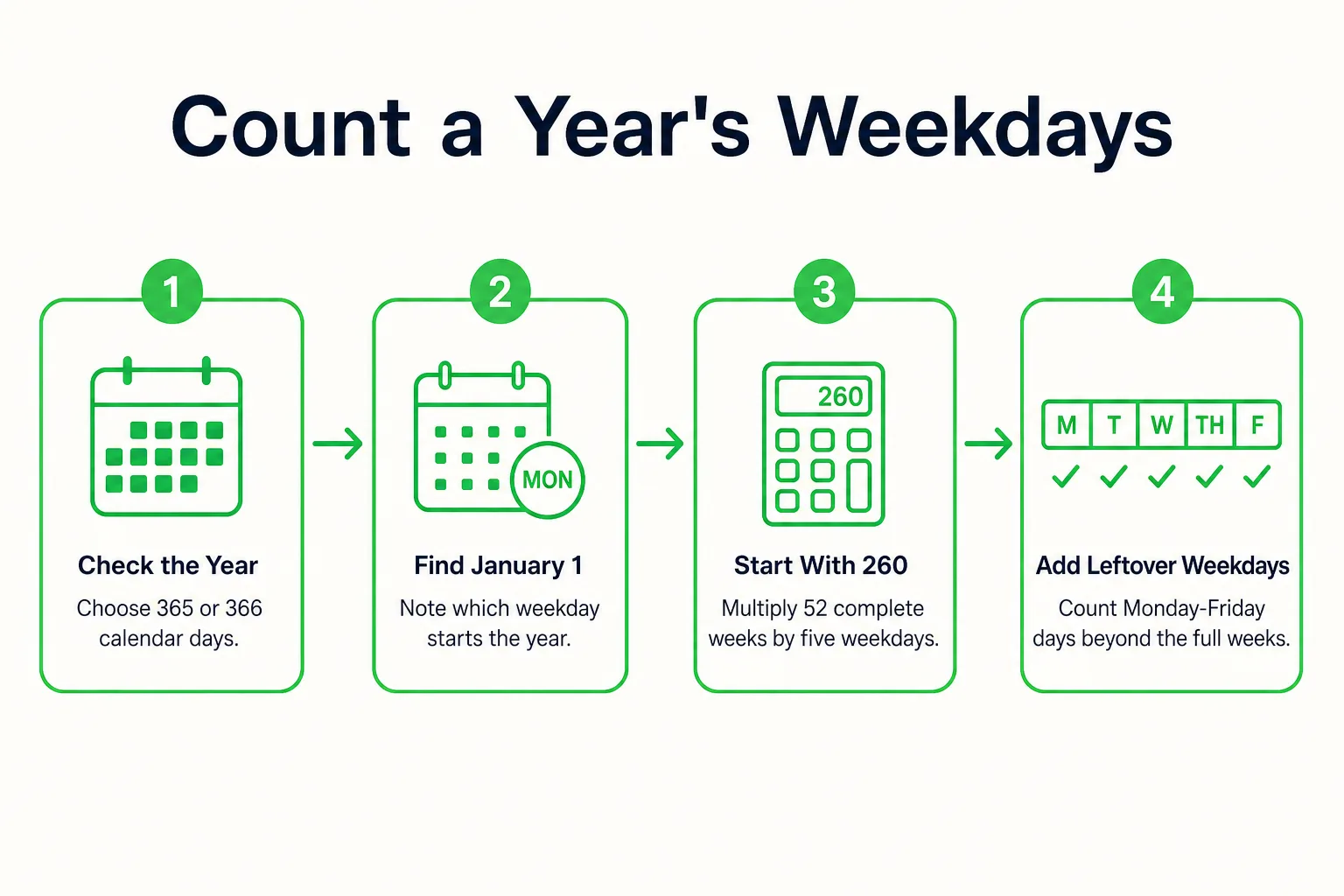
- Identify the year length. A common year has 365 days; a leap year has 366. A 365-day year contains 52 complete weeks plus one day. A 366-day year leaves two days after those same 52 weeks. Years divisible by four are leap years, except century years must also be divisible by 400. So 2000 was a leap year, while 2100 will not be.
- Find the weekday of January 1. Check the calendar for the year you are counting. The leftover day or days have consecutive weekdays, starting with January 1.
- Count the weekdays in the complete weeks. Multiply 52 by 5: 52 × 5 = 260.
- Add leftover days that fall Monday through Friday. For a common year, the extra day has the same weekday as January 1. For a leap year, the two extra days are the weekday of January 1 and the following day.
For 2026, January 1 is Thursday. The year has 365 = 52 × 7 + 1 days, so its 52 complete weeks contain 52 × 5 = 260 weekdays. The extra day is Thursday, which adds one.
The leftover days determine the range. In a common year, they add zero or one weekday. In a leap year, they add zero, one, or two. That is why the totals can be 260, 261, or 262, rather than exactly 52 weeks’ worth of weekdays in every year.
Break the 2026 Total Into Monthly Weekdays
| Month | Weekdays | Running Total |
|---|---|---|
| January | 22 | 22 |
| February | 20 | 42 |
| March | 22 | 64 |
| April | 22 | 86 |
| May | 21 | 107 |
| June | 22 | 129 |
| July | 23 | 152 |
| August | 21 | 173 |
| September | 22 | 195 |
| October | 22 | 217 |
| November | 21 | 238 |
| December | 23 | 261 |
To count a month, give each complete seven-day block five weekdays, then check which weekdays fall among the remaining dates. The monthly figures above add up to the annual total.
Dividing 261 by 12 gives an average, not the weekday count for any particular month. Use the actual month when setting deadlines or recurring weekday targets. In a leap year, February 29 moves every later date's day-of-year number forward by one, so calculate that year's monthly breakdown separately.
For a target that ends before December, use the goal countdown timer to keep the deadline visible, then count weekdays within that date range.
Choose the Right Count for Your Planning Task
The right count depends on what you are planning. Here, weekdays means Monday through Friday, before subtracting holidays or leave.
| Planning Task | Starting Count | What to Check |
|---|---|---|
| Calendar planning | The unadjusted Monday-Friday total | Count the full calendar year or date range. |
| Employee availability | Scheduled weekdays | Remove relevant holidays, PTO, sick leave, and other absences. |
| Payroll | The employer's pay-period and paid-day definitions | Check the payroll calendar and the dates included in each period. |
| Project capacity | Weekdays in the project period | Estimate usable focus time after other commitments. |
| Personal goal tracking | Dates the habit is actually scheduled | Count eligible dates, not every weekday by default. |
“Working days,” “workdays,” and “business days” depend on the calendar or policy behind the term. They may not mean the same thing as Monday through Friday, especially when comparing countries or organizations. Check the definition before using a count from somewhere else.
Federal employees receive 11 paid holidays, so a weekday count alone does not describe days available for ordinary work. That federal example does not set the holiday schedule for every U.S. employer. For most federal employees, Saturday holidays are generally observed on Friday, and Sunday holidays on Monday. Use your employer's observed calendar and count only dates inside your planning period.
When adjusting a schedule, remove each unavailable scheduled date once. If a holiday overlaps a PTO day, do not deduct the same date twice. Paid time and time available for a task are different measures, so choose the one that fits your planning question.
Turn Weekday Counts Into Targets You Can Keep
A useful annual target names a behavior and leaves room for an ordinary week, including missed days. Build it from dates you can actually use, rather than dividing an annual total into identical weekly quotas.
- Choose the behavior. Make it specific, such as completing one 25-minute focus session.
- Mark eligible dates. Start with the weekdays on which you intend to do it. If the behavior can happen on weekends too, add those dates separately.
- Remove known unavailable dates. Check employer closures, planned PTO, and other absences in your own calendar.
- Reserve a buffer. Leave some eligible dates unassigned for disruptions or weeks when the plan does not fit.
- Set practical weekly or monthly targets. Place the remaining opportunities on actual dates, then adjust for months with travel or leave.
Here is a complete example you can change to match your calendar. Jordan starts with 261 weekdays in 2026. Jordan's employer calendar has 10 weekday closures, Jordan plans 15 PTO days, and Jordan reserves five additional absence days. Assume none of those dates overlap:
261 - 10 - 15 - 5 = 231 available dates.
Jordan chooses a buffer of 21 dates, leaving 231 - 21 = 210 planned practice opportunities. At one 25-minute focus session per opportunity, the plan is 210 sessions, or 210 × 25 = 5,250 minutes = 87.5 hours. Those are choices in Jordan's schedule, not a general measure of how much time anyone has available.
Next, Jordan places sessions on eligible dates, checks how many fall in each month, and lowers the target in months with known travel or leave. The annual average is a planning reference, not an identical quota for every week. To test whether 25 minutes fits a real work block, time a trial work block with the aesthetic stopwatch before assigning that duration across the year.
If Jordan misses a scheduled day, the rule is to resume at the next scheduled opportunity. Move a session only when an open slot exists. When the calendar changes, count the future eligible dates again and revise the remaining target if needed.
Before choosing a buffer, use the year in review generator to reflect on last year's commitments. Then turn the next stretch of eligible dates into concrete actions with the 12 Week Year planner.
Put Your Weekday Plan Into Practice With Loggd
Carry your chosen annual baseline into Loggd as a plan you can adjust. You set the calendar assumptions yourself; Loggd helps keep the goal, habits, tasks, and focus sessions together.
- Create a goal for the outcome you want to reach. Keep the target tied to something you can act on, such as completing a planned number of focus sessions.
- Set a flexible habit schedule for the weekdays you expect to be eligible. Leave out dates you already know you cannot use.
- Add one-off tasks with priorities and tags so the next actions are clear. Connect those tasks to the goal they support.
- Use the focus timer for planned sessions, then review your completion in the daily check-in. Tasks and focus sessions connect with goals, keeping the work attached to the outcome.
Checked-off days fill a grid of your last 365 days, giving you a view of recent consistency. That rolling view is different from a January-to-December weekday total, which counts the dates in one calendar year.
If your schedule already feels crowded, use our guide to how many habits to track at once before adding another recurring commitment. Set up your weekday habits, tasks, and focus time in Loggd. It is free on iPhone, Android, and the web, with no credit card needed. Choose your next eligible date and schedule one session.
More Questions About Counting Weekdays
How many weekdays are in a rolling 365-day period?
A rolling 365-day period contains 52 full weeks plus one extra day, so it has 260 weekdays before counting that extra day. The total is 260 or 261, depending on whether the extra date falls on a weekday. The result can vary as the start date moves.
Does a leap year always add one weekday compared with the previous year?
No. A leap year adds February 29, but the number of weekdays in the full year depends on which weekdays its two extra dates land on after 52 complete weeks. The total may be 260, 261, or 262, so compare the actual calendar years rather than assuming the increase is one.
Does a five-day workweek count as weekdays if I work Tuesday through Saturday?
For this article, weekdays mean Monday through Friday, so Tuesday through Saturday is a different five-day schedule. To plan your own availability, count the dates you are actually scheduled to work and account for holidays or leave under your calendar.
Can I use a calendar-year weekday total for a fiscal year?
Use a calendar-year total only when your planning period runs from January 1 through December 31. A fiscal year may start on a different date, so count the Monday-through-Friday dates between its own start and end dates, then apply the relevant holiday and leave adjustments.
Sources
- Why Do We Need Leap Year?
- Leap Years
- Day-of-Year Numbering System
- Leave, USAJOBS Help Center
- Federal Holidays